

Turns out AI isn’t very popular. Who’d have thunk it?
As you’ve probably read by now, last Tuesday, voters said no to AI. 40 out of 41 times in fact. More than half of voters called data centers a crucial or major factor in their House vote. Three in four opposed a new data center in their own community. It wasn’t the only driving force of the electorate, but there is no doubt: AI took a big L.
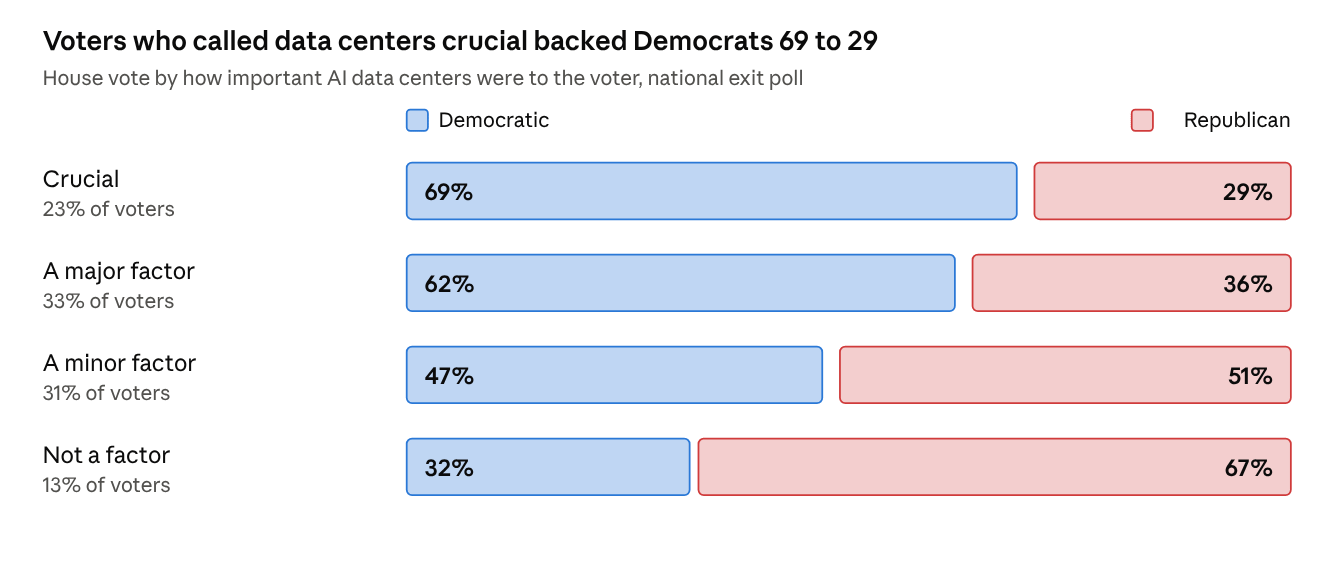
Source: NBC News national exit poll, conducted by SSRS, Nov. 3, 2026. Remaining shares voted for other candidates or didn’t answer.
Built for executives, rejected by voters
Maybe AI’s unpopularity has something to do with how the people selling AI market it.
In the two weeks before Election Day, Marissa Mayer told the New York Times she had asked her new AI assistant to name three things that make her 10-year-old daughter special (empathetic, creative, and an animal lover). Pleased with the response, Mayer missed the obvious: who asks a machine what’s special about their own child?
At the same time, Sam Altman went on a podcast and called it “quite terrible” that memory chips sit in people’s home computers when data centers could use them. Sure, why should anyone bother with a personal laptop? You can have the RAM, Sam.
AI executives are confident that their technology will change society and their companies’ trillion-dollar valuations back them up. We at SCE use AI every day, and we’ve watched it help caseworkers, researchers, and advocates build tools in an evening that used to take years.
But these executives don’t inspire trust that this change will be for the better, and in our democratic society, ordinary people want a say as the world shifts beneath their feet. People weren’t asked to judge AI in all its forms; they were asked to judge a deal: host a building the size of a shopping mall that hums all night, watch your electric bill go up, and see the returns leave town. Of course voters said no.
AI is stuck in the efficiency trap
Why does an industry this smart keep misreading the room? The most useful answer we’ve found comes from Jae Yeon Kim, a public policy professor at UNC Chapel Hill and a former data scientist at Code for America. He laid it out in his Sherman Family Emerging Scholar Lecture at the Korea Society in Manhattan last week (video here).
Prof. Kim’s starting point: anyone building for the public has two jobs. They have to know how to build things, and they have to build the right things, by listening to people and correcting course. Those are separate skills, and you can be great at one and bad at the other.
His case study is Korea, which builds fast and well: one integrated subway network of 24 lines, one website for 55 benefit programs. Yet its main government portal has frustrated people with the same login problem for two decades. In March, the government added yet another feature, this time an AI assistant. Koreans still struggle to log in.
Prof. Kim calls this the efficiency trap. AI is a force multiplier: it speeds up and scales whatever system it sits on. Point it only at building and you build the wrong things faster. Point it at listening and you can climb out.
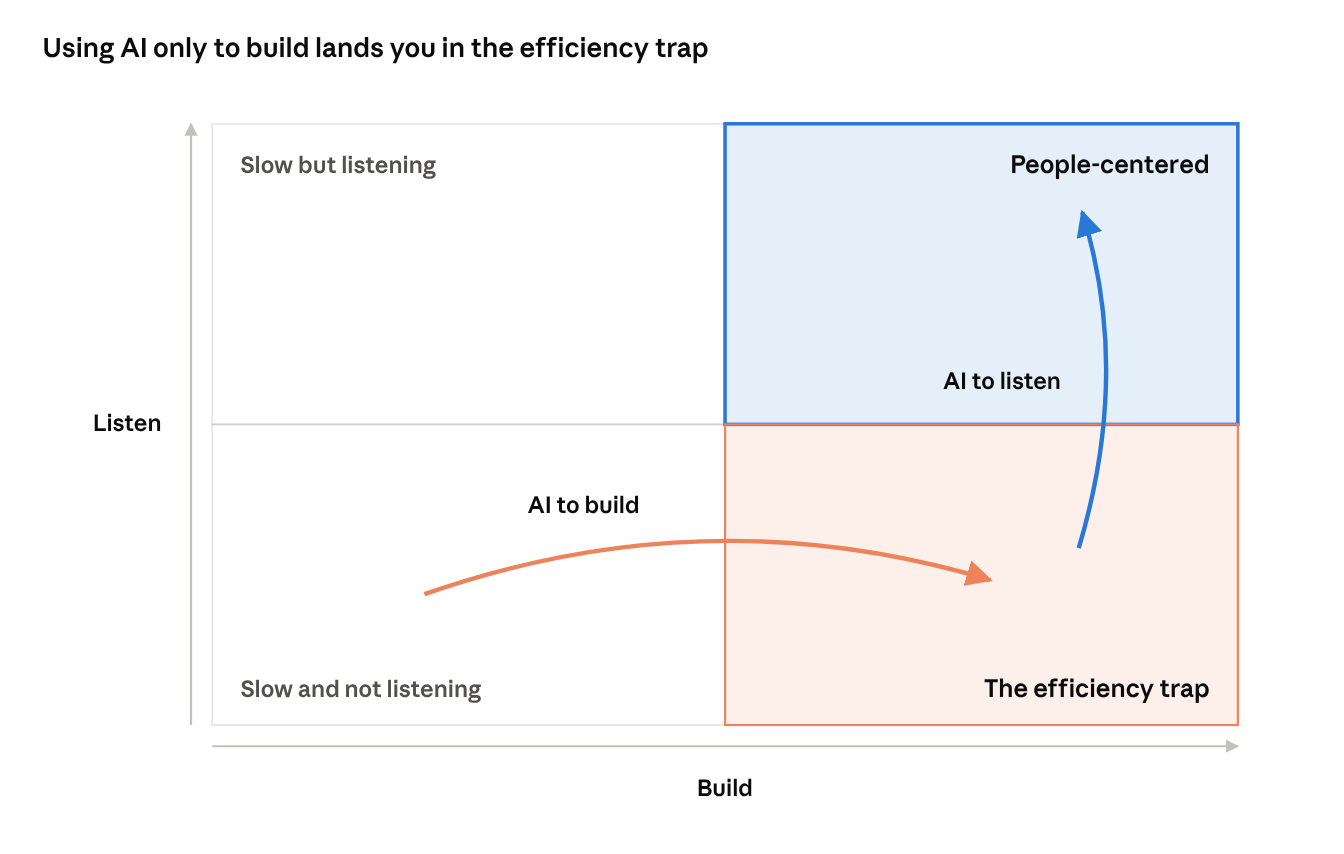
Adapted from Professor Jae Yeon Kim, Sherman Family Emerging Scholar Lecture, The Korea Society, Oct. 28, 2026.
AI is stuck in this efficiency trap. As a technology, it has developed and been adopted at a pace matched by few technologies in history. But its record on meeting society’s needs has been decidedly mixed, with much of the value it has produced inaccessible to the average person. To put the political zeitgeist in tech terms, Tuesday was AI’s first real user research.
Escape demands a new standard
Voters don’t need convincing that AI is impressive. Voters want to know how it’s for them. Climbing out of the efficiency trap takes three things.
Build for real people. People care about the cost of living. AI companies (and Government, tasked with meeting the will of the people) can use AI to make groceries cheaper, make it easier to build homes, and expand ownership of small businesses.
Talk to people like people. With AI, trust is fiduciary, and trust is all about communication. Show people how AI can be used to help them put food on the table and help them train for the jobs of the future.
Rally around a new standard: Inclusive Building. AI that is equitable and accessible by design, built with the people it’s meant to serve, on infrastructure that pays its own way in the towns that host it.
Inclusive Building means a better deal
Core to the Inclusive Building mandate is a deal where everyone wins.
Data Center Bill of Rights. Rep. Ro Khanna’s Data Center Bill of Rights would let communities reject projects and require clean energy and enforceable community benefits. Rep. Henry Cuellar’s Ratepayer Bill of Rights boils it down: if a data center creates the cost, the data center pays it. Rep. Debbie Dingell is drafting her own version. Together they add up to something like this:
The data center pays for its own grid.
It brings its own clean power.
The town gets a binding benefits deal.
Household bills don’t go up.
AI As Taxable Revenue. A bill of rights handles the local costs, but the bigger question is who shares in what AI produces.
Assemblymember Alex Bores ran for Congress on an AI dividend: direct payments to workers displaced by AI, funded partly by a “token tax” on AI use. An AI-industry super PAC spent more than $7.6 million against him, and he lost his June primary.
Senator Bernie Sanders has called for a “robot tax” on companies that replace workers with AI, and in June he introduced a bill that would have the federal government take a 50% stake in leading AI companies to fund a public wealth fund.
AI For The Public Good. Last month, Anthropic said it would put 5% of its shares into a public benefit fund that could make direct payments to affected groups. This announcement barely registered outside tech circles. Critics pointed out that the fund is a company-controlled LLC and that the details on who gets paid, and when, haven’t been disclosed. Totally fair. But Anthropic had the right instinct, and more companies should be competing to top it.
Government’s Role. Government must take up the mantle and actively direct AI use towards issues that matter to real people. It can use efficiency gains from AI to improve services and deliver more value to residents, and it can do so with inclusivity at its core.
A short parting note
It should be noted that the SCE team are not AI policy experts, nor should our highlighting any policy above count as its endorsement. But the broader conversation must be had.
For any tech executives who might stumble across this post: Before the next podcast, ask your AI assistant what a voter in Texas, New York, or Maine will think of your talking points. It may come back with a bland, generic replacement. Chances are that might still be an improvement.
Are you a government practitioner with a problem worth solving? A builder looking for a civic itch to scratch? Someone who thinks we got the map, the mission, or the design completely wrong? Tell us by filling out this short form or come argue with us in the Slack.