


Guess what? The government can build software now. Colorado dissolved its own digital service in favor of a full structural transformation because the model worked too well. New York just put five product teams on the city payroll. New Jersey wrote its innovation office into law.
But while the government builds muscle for yesterday’s digital problems, the private sector is already solving the next challenge: deploying AI. Sit this one out and the government risks falling into the same patterns that got us here in the first place.
The rise of the Forward Deployed Engineer
AI can be a transformative technology. From data extraction to process completion to rapid prototyping, tools available today can increase productivity by multiples.
Applying AI well is difficult. It means mapping a process in detail, understanding why it works the way it does, and knowing exactly where AI helps and where it doesn’t. This work requires technically savvy individuals capable of embedding themselves inside client organizations, building trust, and delivering value. Tech calls this role the Forward Deployed Engineer.
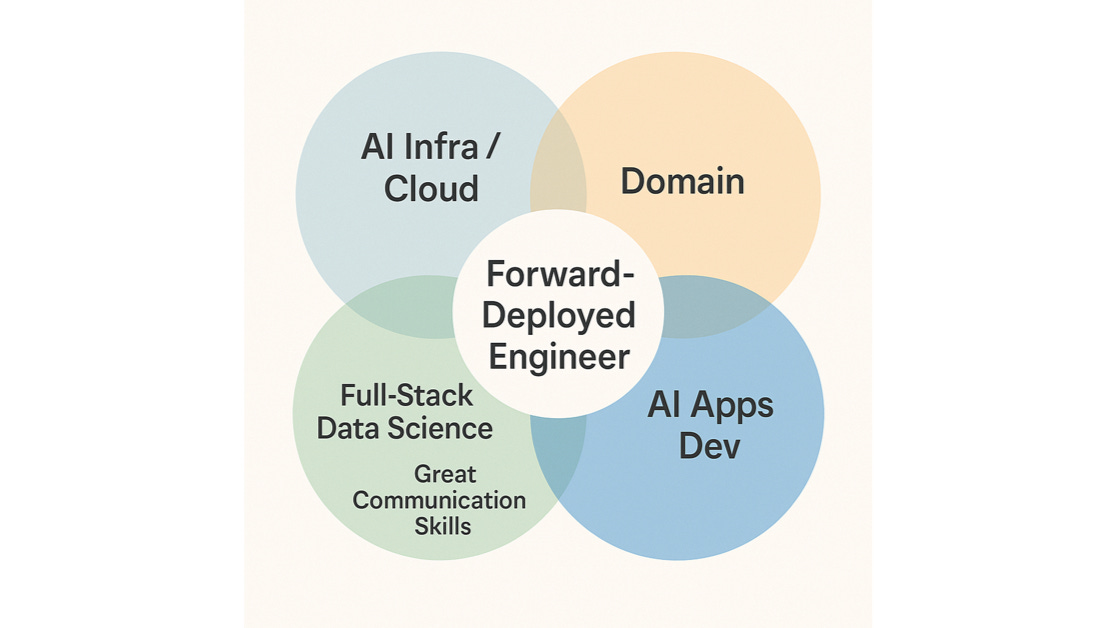
Palantir built an entire business on embedding engineers inside client organizations to ensure their technology worked in production. Every major AI company has since copied it. Job postings for the FDE role are up over 700% year over year, and a July census of just eleven companies found close to 300 open roles. OpenAI launched a $4 billion subsidiary built entirely around the role in May. AWS committed another $1 billion in June. S&P Global found that 42% of companies abandoned most of their AI initiatives in 2025, up from 17% the year before, proof that deployment expertise, not the technology itself, is where the real value lies.
Acknowledging that properly deploying AI seems to require these talented individuals, the question becomes whether to rely on vendor expertise or build in-house. This is both an equity question and an operational one.
Forget FDEs: government must hire its own AI engineers
An AI system built by a vendor optimizes for two things: contract compliance and profit. An AI system built by a government AI engineer can optimize for the resident calling about a benefit, the small business owner filing a permit, the parent who needs a form in another language.
Done right, in-house AI deployment makes government fairer and more inclusive. AI tools can be designed to meet residents where they are, address a laundry list of edge cases that would otherwise go unsolved, and allow for live prototyping, feedback, and iteration. Left to a vendor optimizing for contract terms and resale to the next twelve agencies, the same tools tend to default to whatever is contractually aligned, not what actually serves the public. The constituents most in need might not be able to use the tool at all.
The operational case is just as strong. Policy does not sit still. Tal Roded recently mapped how many standing obligations New York City agencies answer to at once: more than 8,000 obligations from the City Council, roughly two-thirds of them recurring every year, with new ones added constantly. Every one of those can change what an agency’s AI workflow needs to do next month.
A tool only the vendor can change is a tool the government does not actually own and cannot actually use. A tool agency staff can adjust themselves is the difference between fixing a workflow in a week and renegotiating a contract for six months. Just like with other technology, vendor-built AI bills you every year for the privilege of staying dependent.
What building AI in-house looks like
New Jersey’s Office of Innovation is already modeling in-house AI expertise. The state was an early adopter of AI through the NJ AI Assistant, an in-house chat tool that allows thousands of State employees to work more efficiently, hosted on secure infrastructure at roughly 1/20th the cost of a commercial product. The office has since built reusable tools for agencies to speed up tasks like reviewing documents and drafting memos. These tools turned weeks-long reviews into hours of work, while keeping humans in the loop and honoring the high standard of trust residents expect of the government.
Congress is also weighing how to actualize its own AI adoption. Representative Stephanie Bice, who chairs the House’s Subcommittee on Modernization and Innovation, requested funding this summer for Mia, a secure AI agent connected to data across the House, built through a pipeline that trains staff to build these tools themselves instead of buying them off the shelf.
Delivery ultimately reflects the same model State Capacity advocates have championed for years. A government AI engineer sits with staff members before writing any code, long enough to learn what the decision actually requires. They curate the evaluation set: what a correct answer looks like, on which cases, at what error rate, who reviews the misses. They own the data pipeline, so accounting for a new team process does not require a full rebuild. They outsource when necessary, but they read the contract closely enough to know what is being given away and how to hold the vendor to account. And they build the small thing in-house when the small thing is enough, which is more often than a vendor pitch will admit.
As for the cost of that engineer? Agencies already pay for this work, just buried inside an implementation line item instead of a headcount line. New York’s entire PIT Crew initiative costs less than what a large agency spends on a single modernization contract.
Digital was never the point
Colorado’s real lesson is that the government needs to and is capable of responding quickly and authoritatively to emerging technology. AI is just the next evolution of that challenge.
We cannot afford to wait. Talent is being snapped up by AI labs, start-ups, and consultancies. Governments own very little of the AI expertise today, and every month that passes, more of it accumulates elsewhere.
The agencies that hire their own AI engineers now are the ones who get to decide how AI actually shows up in their residents’ lives.
Are you a government practitioner who wants to use AI and technology to do your job more effectively and efficiently? A technologist who wants to dip your toe into the civic realm? An expert in government who thought our article was spot-on, completely off-base, or somewhere in the middle? Tell us more by filling out this short form.