

TL;DR
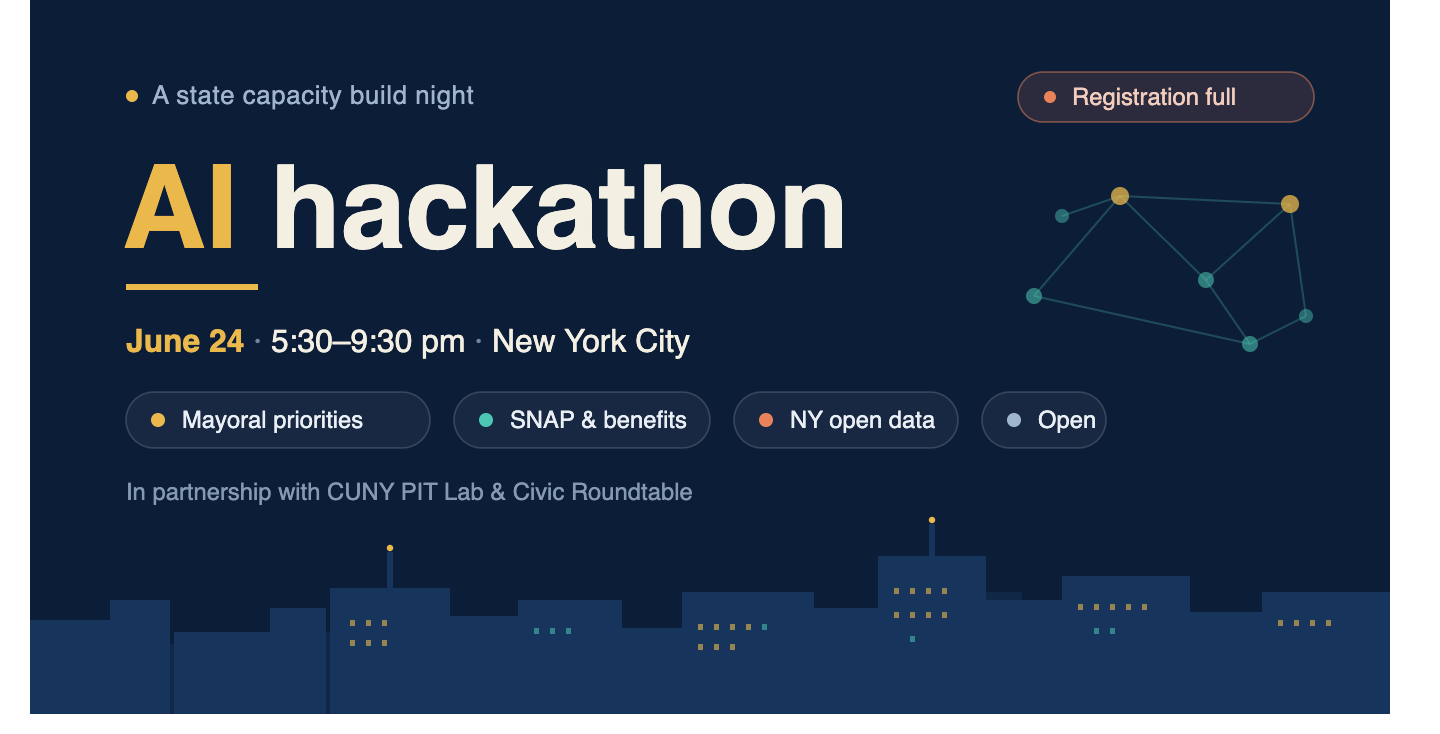
We’re hosting an AI Hackathon on June 24 in New York City, 5:30 to 9:30 pm. Attendees will pick a real problem, join a team, and ship something by the end of the night.
Within a week of our launch, we hit the registration cap for the event. For those who did not register but are interested in getting involved, we recommend subscribing to this Substack and adding yourself to our Connect page. Future hackathons and events will be announced here first.
Thank you to our partners, CUNY PIT Lab and Civic Roundtable.
Read on to learn more about the event, including our announcement of the project tracks, judges, and logistics.
Why the hackathon exists
Our build night is a forcing function. Real problems. People from different corners of the State Capacity ecosystem. Grassroots community, hacky approaches. The point isn’t a finished product by 9:30pm. The point is to start putting practitioners and technologists in the same room, on the same problem, at the same time.
You don’t need to be a developer. You only need to care about the problem and be ready to experiment.
How the night will run
5:30
Doors open. Pick your track, find your team, grab a slice of pizza.
6:00
Kickoff: welcome, format walkthrough, and a brief from Civic Roundtable on building for the civic sector.
6:15
Judges lightning round: 2–3 judges share one problem they’ve seen up close and what they want to see built in their track.
6:30
Teams form and build. Judges and staff roam the room.
8:45
Demos begin. Three minutes per team: a working prototype, dashboard, or AI-assisted workflow. No decks.
9:10
Judges deliberate and name standout teams.
9:25
Wrap: next steps, community announcements, and how to stay connected.
The tracks
Projects are suggested to follow one of three tracks – Mayoral Priorities, SNAP and Benefits Delivery, NY Open Data – or can be submitted under the Open category.
Each track has a real problem statement sourced from a practitioner.
Mayoral Priorities: Agents supporting the incoming administration: grocery store siting, permitting reform, tools to help small businesses navigate city services.
SNAP and Benefits Delivery: Eligibility prescreening, application support, and caseworker tools built for a policy environment that keeps changing.
NY Open Data: Making NYC’s open data actually usable: plain-language Q&A, consultation summaries, dataset-to-answer pipelines for people without a data team.
Open: Bring your own live government problem and recruit collaborators on the night.
The judges
Judges and supporting staff from New York Government, Academia, GovTech (and more) will roam the room, give feedback, and name standout teams at the end of the night.
Dan Steinberg
Dan has spent over a decade building the data and performance infrastructure that makes city government actually run. He’s now leading NYS OPMI: an office recently created by Governor Hochul to strengthen statewide performance management systems, support data-driven policymaking, and help execute cross-agency initiatives. He knows what operationalizing technology inside the government looks like.
Executive Director of the new NYS Office of Performance Management and Innovation (OPMI)
Director, NYC Mayor’s Office of Operations
Winner, NYC Hayes Innovation Prize for IT Leadership
Built the Dynamic Mayor’s Management Report: real-time performance monitoring across 46 city agencies and ~22,100 performance indicators
Josh Seiden
Josh co-founded Civic Roundtable and has spent the past several years in the room where the actual work happens: onboarding agencies, running trainings, making sure the technology lands. He’s a co-host of this event and brings a ground-level view of what it takes to deploy tech inside government.
Co-Founder, Civic Roundtable — collaboration platform used by public servants at 1,500+ agencies across all 50 states
Former Senior Director of Strategic Initiatives, Mark43
Former Human Capital Consultant, Deloitte; focused on systems implementations at the Department of Homeland Security
Stephanie Yim
Steph Yim is an experienced multi-disciplinary designer and strategist leading design, research, and implementation of public services at the intersection of government and civic tech. She is a practitioner and educator of community-centered design. As the design operations director at Public Policy Lab, Stephanie partners with government agencies and non-profit organizations to design improved ways to deliver public services to at-risk communities. Steph is a proud native of Queens, NY and daughter of immigrant parents.
Worked for agencies like the United States Digital Service, NYC Department of Education, Robin Hood Foundation, and the NYC Mayor’s Office of Economic Opportunity
Co-founded Good Call, NYC’s first 24/7 arrest support hotline
Over a decade of experience in UX and product design in education, housing, childcare, and benefits access
Benjamin Kallos
Ben has spent his career using technology to make government more open, accountable, and easier to navigate, first as a self-described “political geek squad,” then across all three branches of government. As a New York City Council Member he authored some 60 laws, and most recently he worked in the White House leading cross-agency data-sharing initiatives to make it easier for residents to access human-service benefits. He knows what it takes to turn civic-tech ideas into law and into working systems.
Former New York City Council Member (2014–2021), representing the Upper East Side, Midtown East, Roosevelt Island, and East Harlem
Former member of the U.S. Digital Service in the White House, leading cross-agency data sharing to streamline benefits access
As Chair of the Governmental Operations Committee, worked to root out waste and use technology to improve access to government, including putting NYC’s budget online
Authored the full public matching campaign-finance system and the affordable-housing law behind Housing Connect (housingconnect.nyc.gov)
Attorney at Law, founder of Kallos Law, representing communities, candidates, organizers, and small businesses
What’s next
This is the first version of something we want to keep building. After June 24, we’ll publish a write-up: what teams built, what judges noticed across tracks, where the gaps were, and commitments for what’s next. Subscribe to the Substack if you want to see it when it drops.
And if you want to stay connected to the broader ecosystem — the orgs, the tools, the funders, the fellowships — the State Capacity Ecosystem Hub is here: State Capacity Ecosystem — NYCuriosity Data.