

There’s a lot of hype in technology. AI is changing how we work, solving math problems that have stumped experts for decades, and helping us cure disease.
For those of us in civic tech, the bigger story is inclusivity and accessibility. AI can help us hear constituents who have never been listened to and build technology for institutions that otherwise have neither the money nor the time to build it themselves. For the first time, we’re told building software is something almost anyone can do. Our thing is seeing what that promise looks like in practice.
Once more, together with CUNY PIT Lab and Civic Roundtable, we brought together 80+ technologists who build, practitioners who know the workflows, advocates who ensure equity, and decision makers who use the products. Unlike last time, we gave teams two narrowly scoped themes to see how well they could color inside the lines (with a bit of their own flair, of course).
The first topic was improving community boards. Our own Tal Roded sits on Manhattan’s CB3, and he’s seen firsthand how little tech infrastructure exists for the most local level of community expression in our democracy. We challenged participants to find creative ways to help.
The second came from something any New Yorker has likely noticed: Mayor Mamdani stepping up to fix mundane public nuisance. As much as we admire the Mayor’s dedication to the cause, we figured there had to be a better way for agencies to capture, triage, and act on New Yorkers’ requests. Our second theme, capturing public voices, thus asked teams to generate innovative solutions that might build trust in government by helping the public feel heard.
Our panel of expert judges (hat tip to Jeremy Ney, Abbey Kos, Raj Korpan, Sarah Lind, and Amaury Dujardin!) also pitched their own ideas to the builders, from improving transit-oriented development to centering people and communities in the city’s plans.
Rather than providing prescriptive solutions, we gave teams a direction and let them iterate rapidly on what might actually help. The result, as usual, was a delightful experiment in giving State Capacity enthusiasts real problems, knowledgeable people to learn from, and enough room to surprise us.
Fixing community board operations
It’s a common trope in government that “what to build” can be almost too easy to define, with the resounding answer “everything”; the challenge is knowing where to start. This was absolutely the case for teams working on Community Board tools. With so many critical needs, where to begin?
We were lucky to be joined by a number of community board members-turned-builders, and each tool was designed and built with community board members in mind, including the ones in attendance. Many of the projects were very much of the “scratching your own itch” kind. Prototypes targeted specific, clear needs: fixing broken email-based workflows, serving as (currently non-existent) systems of record for past decisions, and reconciling commitments from members with actual work done by City Hall.
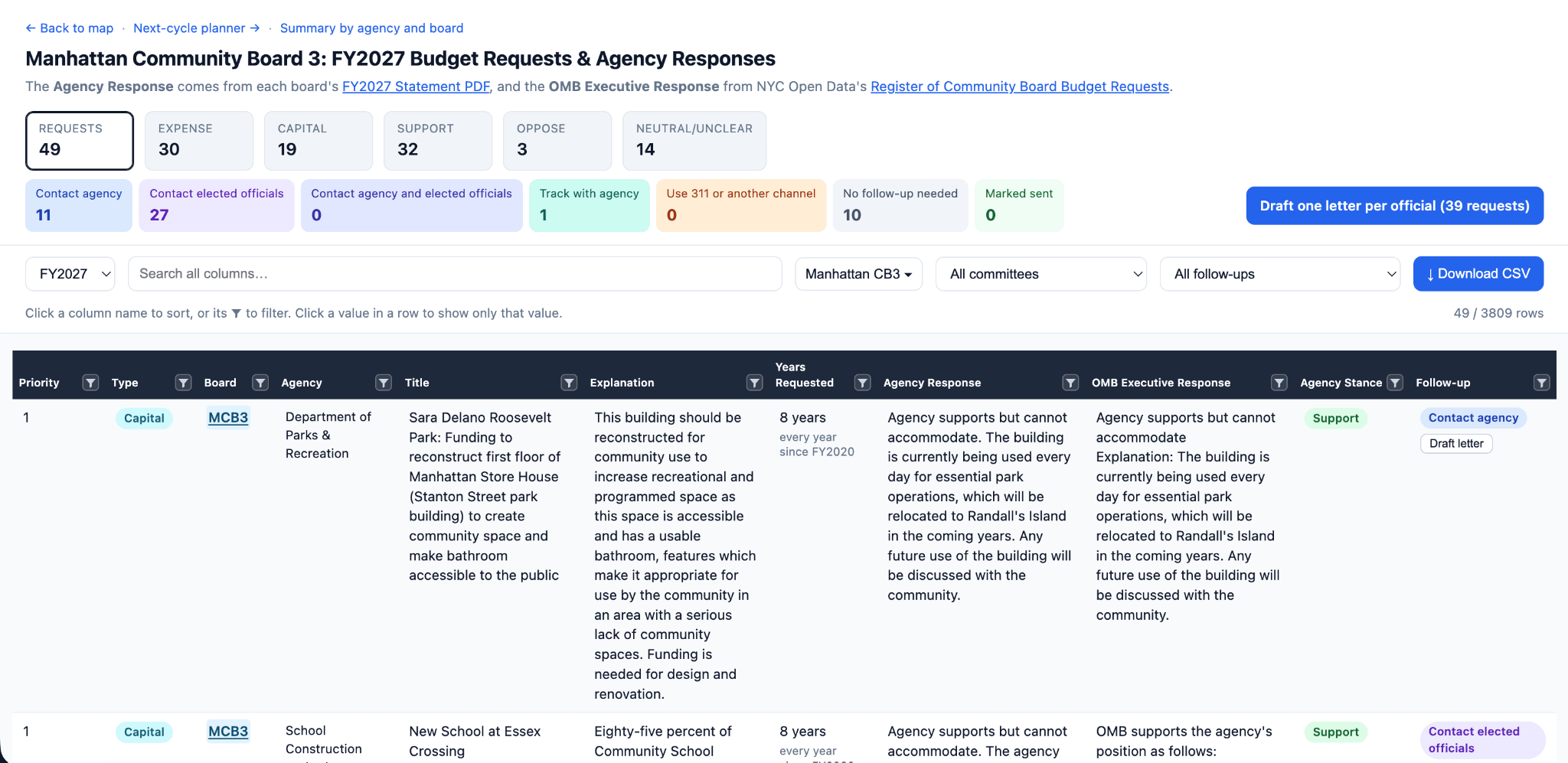
Budget Requests helps members track priorities from their past years’ Statements of Needs and view agencies’ responses, so they can advocate for their needs with those agencies
BoardOS was designed to present a representative with every piece of information they needed in order to be prepared for their meetings, helping extricate them from the process of manually reviewing 12 PDFs before each session
Robert Rules, informed by a CB6 member’s experience arguing about Robert’s Rules of Order, made it easy and fun to teach new members how CB meetings are run
Boardcast helps community board members spread awareness of their meetings by taking meeting notes and turning them into social media posts
The solutions weren’t complicated, but they were previously out of reach, and the most local form of City government has been hindered by their lack. If we can’t get it right at the foundational level, how do we expect to get it right elsewhere?
Capturing voice to build trust
Our second set of projects tackled whether New Yorkers believe the city hears them. They shared a premise: when residents can see they’re being listened to, they invest in the outcome.
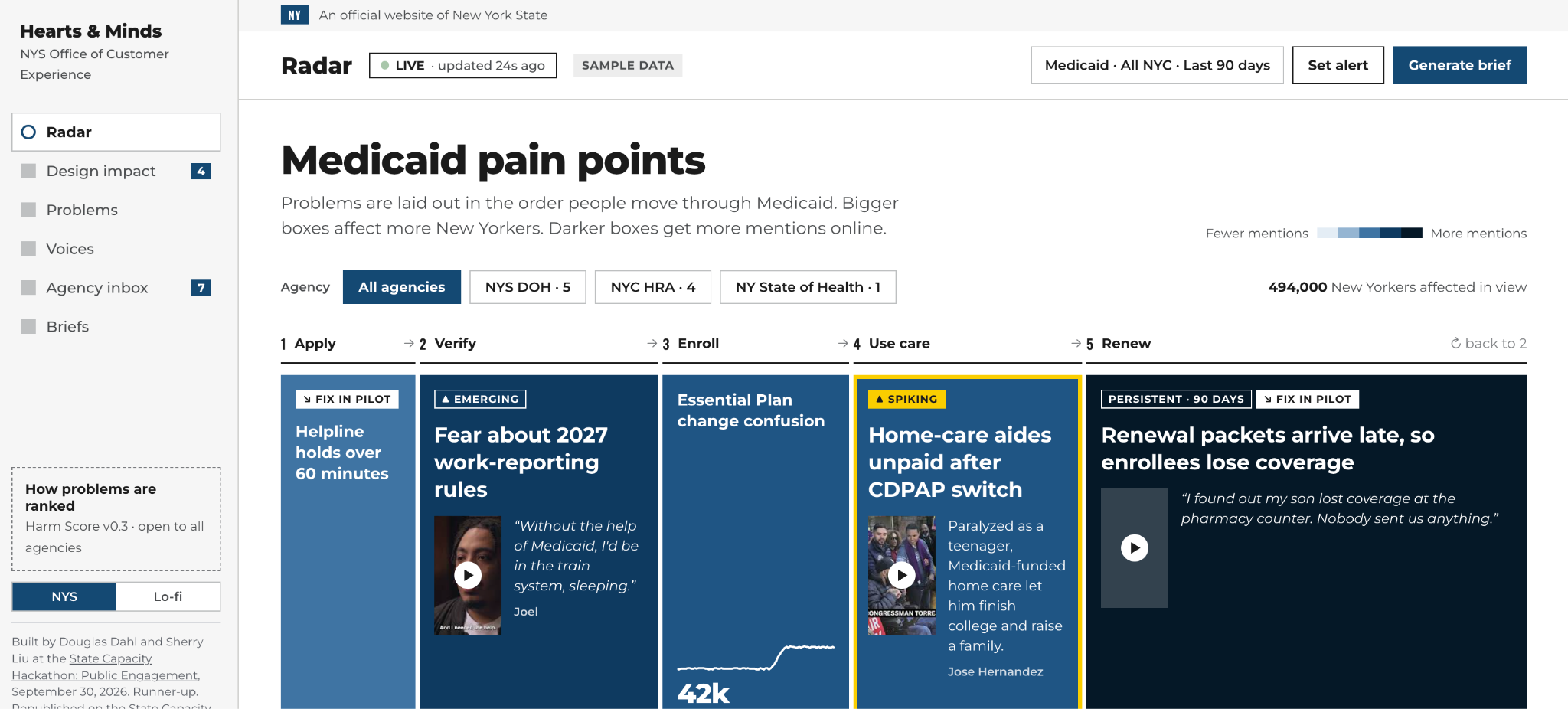
Hearts and Minds pulls together what’s happening on a given issue in a given place, such as the number of residents in a district who lost SNAP benefits under H.R. 1, and sets it next to the public reaction on social media.
“Mamdani, Fix This” takes every TikTok asking the mayor for help and routes it to the relevant agency / a public queue, so a viral complaint turns into something trackable.
These tools are even more powerful in concert. Together, they could give the city a running read on public sentiment and offer residents proof that someone is paying attention.
Judge specials: simple solutions for complicated problems
Much of what cities deal with is just plain hard. Rezoning is a good example: turning a laundromat or gas station into housing runs through land use rules, environmental review, neighborhood pushback, and years of process.
In the Zone skipped the urge to model all of it and built a single map showing where density is low across NYC and what would change for residents and planners if those lots were rezoned. The ability to generate an actual image of what the future could look like (a gas station turned into a residential development, for example) was a huge unlock for our judges, who described countless community engagement meetings trying and failing to help the public visualize a future development or project. A classic demonstration that a picture is worth a thousand words.
What’s next
Across all themes, the strongest projects came from teams who leveraged firsthand knowledge: board members tired of PDF stacks, residents who sat through rezoning hearings, and organizers watching complaints pile up on social media with nowhere to go. Two hours was enough to show that there was something worth building.
That is why we love our hackathons. AI has made prototyping software dramatically easier. The harder part is everything around it: figuring out what problem to solve, designing how the tool should be built, and determining who needs to be involved so that the end product matters in the real world. We design these events to start with the need in mind, not the technology.
What’s next for us is simple. We’re growing the ecosystem. That means incubating projects, holding build-oriented events such as demo nights and hackathons, and hosting community-building events such as salons and meet-ups.
What’s next for you is what matters. You are the ecosystem. We need passionate builders who have a civic tech itch to scratch. We need government practitioners who want to learn how to use emerging technology to augment their work. We want philanthropy and VC in the room to think about funding all work State Capacity. We’re looking for visionaries who might take our efforts beyond NYC.
Perhaps most critically, we are always looking to partner with agencies and departments that want to tackle big, nebulous problems where tech just might help.
If any of this sounds like you, reach out.
And if you just want to dip your toe in the water and be the first to hear what we’ve got going on, the easiest place to start is by joining the SCE Slack.